Monday June 24 – Deep sleep, there’s no way I’m not
dehydrated. Certainly sore from the glutes
on down.
What to do today? I had figured on a hike in Bukhansan National
Park north of Seoul. Reachable by subway,
and a chance to get out of the city and into some nature. But I’m too tired to think straight. Avoiding the issue, I fall back asleep after
breakfast while trying to decide what to do.
Awake again, I look outside. The clear sky of the weekend has been replaced
by a muggy hazy overcast. It’s still
hot, but visibility is down. This plus
the time makes for an easier choice, or perhaps avoidance of choice – Bukhansan
for another visit.
Clean, dressed, to the subway, en
route to Yongsan and the
National Museum of Korea.
I looked at the website before I went – all the
galleries have online VR previews.
Cool.
It’s clearly the work week,
people in business clothes.
Ichon Station and another reason
I like Korea – there’s a direct, clearly signed portal leading to the museum
grounds. Lunch, and into the museum, which
like all the public museums, is free. A
big, modern space, outside and inside:
The interior building
stone for the floors and walls isn’t granite, it’s a very nice fossiliferous limestone.
The Museum covers Korean history
to 1910, and Asian Art with an emphasis on Korea. It’s interesting that it stops in 1910: the
start of the Japanese occupation. Well,
that did pretty much disrupt Korean society, and I expect its modern
incarnation is feels rather isolated from its history. The culture definitely jumped the tracks after
the ceasefire.
Ok, I can do this. I start with Prehistory and work my way
forward in time. The exhibits are excellent,
expanding on what I learned at the Seoul History Museum and the National Folk
Museum. As before, it’s at a more
detailed level than I want to absorb. I
suppose being Korean and coming here is like being American, being taught American
History (I assume this is still done) and then touring to the Smithsonian
Museum of American History. It enhances
the broad timeline you’ve already learned or vaguely remember.
I read the signage and examine the artifacts that interest me.
Who knew that there were Paleolithic petroglyphs
in Korea:
Why wouldn’t there be? Just my ignorance.
As I tour the history exhibits,
the general progression articulated – and it is definitely advancement – is no
surprise. Paleolithic hunter/gatherers
with stone tools to Neolithic crude metalworking and agriculture to Bronze Age
cultures (protokingdoms) to the various increasing levels of organized and
complex societies that flourished and failed in Korea through the early 20th
century. Sounds kinda like every other first
world national history I’ve learned.
Hmmm. I’m also a little skeptical
of the consistently positive evolution that is implicit in the exhibits. Is this my mind organizing things, or Korean historical/cultural
bias/national mythology? Things must have
been a lot messier, at minimum given the hundreds of times Korea was invaded,
or the internal numerous dynastic conflicts that took place. Anyway, the collection is outstanding. Here are National Treasures 191 and 192, a
gold crown and girdle from the 5th century Silla period:

Wow, that was just the first
floor, still two floors of art above me.
Since this is a civilized museum, there is a café on each floor. I have what’s arguably the best Americano of
my trip on level 2 and push on. Through
Calligraphy (too little) and Painting (great stuff, but too dim) including a
powerful 11 x 7 m Buddhist painting. I have
to sit and feel the energy of this for a while.
This stonework counted as calligraphy:
Level 3: Asian Arts, including
metalwork, ceramics, and sculpture. Like
level 2, the emphasis is on Korean materials, which is fine by me. I take random photographs of pieces I like. A bronze rain gauge:
Ornamental brickwork:
My favorite lacquered box:
A Joseon dynasty tray:
More Buddha:
Finally, ceramics. These galleries are arranged by ceramic style
– white porcelain, bucheong ware, and celadon - which would probably mean something to me if I
had ever taken art history. As with the
rest of the museum collections, the display pieces are superb. I’ve never seen bucheong ware before, and I
really like it; it’s a uniquely Korean style, so there’s lots of it. My favorite jar:
Sorry, celadon has never appealed
to me, so no pictures. But there was
also a small exhibit of black ceramics, which I like as well:
Enough art and history for one day,
so on to the 21st century.
Some of you may have heard of the Gangnam district of Seoul, made famous
by a certain K-pop video that I have never seen,
OK? Really. Gangnam is south of the Han River, a short
subway ride from Yongsan.
Gangnam is known for its Korean
nightlife, but I went there in order to 1) say I’d set foot in district and 2) go
to Samsung D’light. D’light is basically
an Apple store that has taken lots of performance enhancing drugs. A showcase for the current and future tech
that Samsung hopes to sell to us. If you
are all worried about the coming technological singularity, when the machines/AI take over, this is not your place. Picture and name appear above check in:
A pretty global attendance.
Anyway, it was a fun interactive
experience. I get a wristband
which triggers a series of interactive experiences around the theme of “Live
Your Tomorrow”. Here’s what it told me I
am:
My preferred future:
You can decide. Note that everything was in English. I don’t remember choosing a preferred
language, but I expect this changes appropriately.
Sufficiently inspired, I
proceed upstairs to the future technology showcase, such as this giant curved 8K monitor:
Would not fit in my house.
The coolest bit of this was a
series of AR (augmented reality) demonstrations of Samsung’s internet of
everything lifestyle of the future. At
each point, you picked up a tablet, and it showed a short video of a family
living in a totally connected house. The
video view changed as you moved the tablet around. For example, in the picture below, you can
see the real white kitchen in the background and the virtual one (with mom
making dinner) on the tablet.
An interesting vision, but no, I’m
keeping my house as unwired as possible.
The bottom floor of D’light was
the store (I wasn’t shopping: Korea runs on 220V). Computers, phones, monitors, appliances, and
best of all massage chairs, where I took a badly needed 15 minute break. I almost fit in the chair. I’d get one of these if it did a better job
on the legs.
Enough for one day. Subway home.
Here’s a digression on the Seoul subway. As I wrote
in an earlier post, the system has over 340 km of track and 22 different lines –
about three times the size of the BART system in California. The annual number of rides is some insane
number in the low billions (10x-20x BART). Several major stations integrate with the
national train system, and there are stations at Gimpo and Incheon
International Airports.
The system map is basically spaghetti:
Overwhelming, but I had a killer
Seoul Subway app which gave me route planning, told me which direction to go at
each station, when to transfer, the number of stops to ride, and other making-me-more-secure
information.
The signage and maps in every
station, in Hangul, Chinese, and English, were also excellent: very necessary as every one of my trips required one
or more transfers.
Sometimes this
required a good half kilometer walk – the app estimated walking time (but did
not include time for dodging Koreans in a hurry or getting lost).
This video gives a feel for the subway experience.
I bought a T Card as in the video, much
easier than single ride tickets. All the trains and stations also have free 5G wireless:
The subway is very
civilized. Clean. No music or food noticeable. All the trains were the same length. Floor signage made clear where the doors
would open¸ every time. No pushing/shoving to get on or off. Reserved seating for the elderly/infirm/etc. If you sat there without these characteristics,
you got the snake eye. There were also seats
specifically for pregnant women: almost always empty, except on the lines where
a small stuffed animal of indeterminate species further reminded you not to sit
there:
People were helpful, more than
once I was almost led by the hand to where I needed to go. All the trains had real-time announcements and
signs (eventually in English). After initial,
whoa, this is huge, I felt very comfortable riding around.
Many stations were multi-level
and were deep underground. This may have
been to get into the consolidated alluvium which must underlie Seoul, or even
into the bedrock. I wonder if this was
an engineering or defense decision, or both.
There was also a lot of space for stores and vendors selling pretty much
everything you might want to buy or eat.
Clean restrooms. Worryingly, a lot
of emergency stations with fire extinguishers, first aid, and many, many gas masks:
Tuesday June 25 – A better rest, but my body feels achy today. I will assume this is cumulative exhaustion from
three days in Seoul with my finger on the fast forward button, rather than an
illness. It better be; among my decisions
yesterday was signing up for a tour of the DMZ.
Yes, that DMZ. One can only visit on an organized tour, for
obvious reasons, like getting shot or stepping on a land mine. This is a day trip from Seoul: the DMZ is at
most 40 km away. That’s well within
range of all kinds of bad stuff if the war ever resumes.
At 8 am I presented myself at lobby
of the Four Seasons Hotel (near the Kings Garden) to meet my tour guide. Dissonance; a brief step out of Seoul and
into five star international hotel vibe. A number of other tourists and tour guides
trying to find each other. The staff seem used to this as a rendezvous point.
Pretty much on time, Shiny
appears and homes in on me. I join her,
our driver, and six other tourists in a minivan. As we start the hour plus drive to the DMZ, Shiny
(who I gauge at late 20s-early thirties, moderate winsome princess style) explains
that her name comes from her surname of Shin, anglicized for fun. She gives us interesting background on
the Korean War, the DMZ, and most poignantly, what this meant to Koreans. Here family was from the north, and her
generation is fully out of touch with their family there.
Traffic fades with distance from
Seoul. All that’s left on the road are our minivan, other minivans, and several dozen
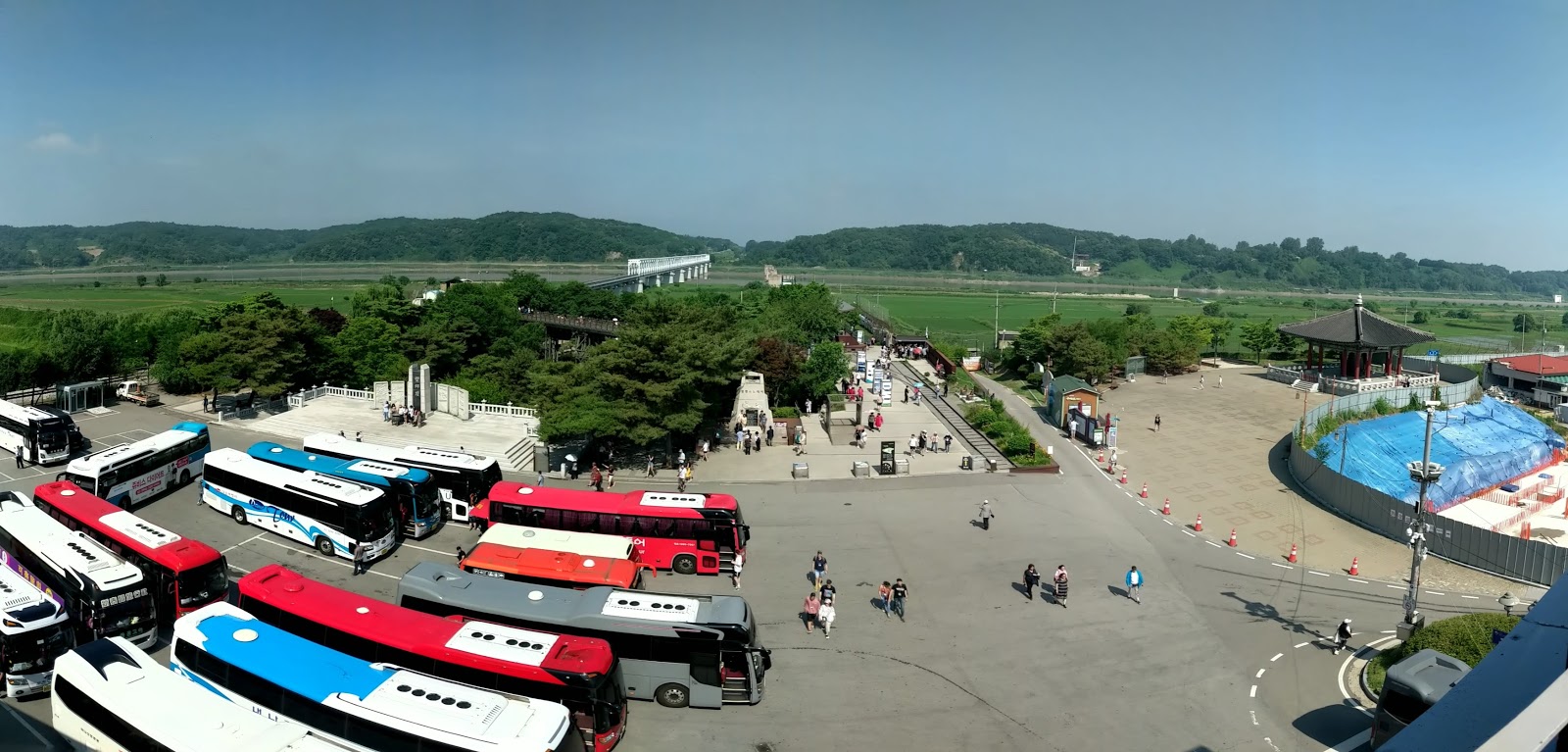
busses. Going to the DMZ is a
thing. We pull into a massive parking
lot, where we will board a bigger bus for the rest of tour. This stop is to
overlook the Reunification Bridge; where families met for a time before the
current tensions:
Many reminders of the pain of
separation:
Shiny in action:
We proceed to the Dorasan train
station. South Korea built this to be a
real functional stop on a future rail line to North Korea and ultimately China,
Asia, and Europe:
Don’t buy your tickets
yet. The roads on the map were briefly
functional when South Korea operated an industrial zone just across the DMZ. All shut now.
Dorasan is a bit creepy; a real
station, but just tour groups now:
And aspirational artwork:
A real train that got
shot to bits during the Korean War.
The idealized future.
I like Shiny’s approach. She’s funny and sweet. At each stop, she gives us an overview and her
recommendations of what to prioritize, as well as logistics like where the
bathrooms are and how much time we have.
Then she turns us loose to poke about independently. I do wonder if she is required to adhere to a
specified point of view when it comes to the politics of the DMZ; reunification
is presented as this glorious, desirable, inevitable future, no
mention of future war, moderate glorification of Korean leaders (all men).
Here’s one of the
several reunification sculptures I saw.
Popular for selfies.
On the bus, into forest. Shiny tells us that there are over 2 million
land mines on the land around us. We
cross a rather mundane blue stripe on the road. We are now in the DMZ. We go to the Dora Observatory for a look at
North Korea. The weather was still hazy,
and it was near midday, so the photographic conditions were crap, but I try
anyway:
The DMZ is the wooded area in the
foreground. Shiny told us that you can
tell where North Korea starts because the trees vanish across the river (center
of picture). Cut for fuel.
Final stop is the “Third Infiltration
Tunnel”, one of the several dozen passageways that have been discovered:
Mannequins. The tunnels go south, as you might
expect. We get to walk 73 m underground
and into it (no pictures allowed):
It’s almost funny. Here I am in a long single file line of people
going down a 20% grade access tunnel, to walk through this tight tunnel
that North Koreans blasted through the granite bedrock. It’s well-lit with plenty of ventilation, but
tight enough that it would not be good if I were at all claustrophobic. We have to wear hard hats, which is good as I
hit mine regularly on the low ceiling. I
have to crouch most of the distance. Groundwater drips. We come to the turnaround, and for a few
seconds get to peer through the small window in the first of several thick
walls blocking the tunnel. OK, we are almost
in North Korea, but this long walk for this?
It meets the Weta test for sure.
I also enjoy the stiff climb back up the access tunnel; this counts as exercise.
Back on the bus, back to our
minivan, and back to Seoul. I fall
asleep. We are dropped off at the Seoul
City Hall (a major subway nexus). Goodbye
to Shiny.
I am tired, but I promised myself
one more stop, so I subway to Itaewon.
This district might be familiar; it was where the big US Army base was
until a decade or so ago.
Still full of foreigners.
I’m going there to see the
Leeum Samsung Museum of Art:
Highly recommended in my
guidebooks. For 11,000 won, I get
admission and an audio tour: a Samsung phone with earpiece. The audio tour is by far the best I’ve ever followed. Instead of overlying long pedantic signage, every
artwork has audio interpretation (with additional text); just enough to understand
what you are seeing. Better yet, the
audio starts automatically as I pause in front of each piece. Brilliant.
No photography. Museum 2 is three floors of modern art with themes
of “Beyond Boundaries”, On Abstraction” and “Toward Expression”. Korean and international artists. Oh. My. God. I have never been a gallery where every piece
is a home run, much less brilliantly juxtaposed with works by other artists. I don’t like everything, but it’s impossible
not to be moved by such masterpieces.
Done, I breath deeply and go to
Museum 1, which shows Korean art up through 1910, similar to the National Museum. Oh. My. God.
I thought the material in the National Museum was good, this is
better. Not a lot of works, but enough
to fully communicate artistry, evolution, and brilliance. There is more bucheong ware, which I like
even more. Further, a few modern works
are here, set to complement the traditional art. There is an arrangement of bucheong ware set
by a Rothko painting that almost makes me weak at the knees. Or this might be fatigue.
Done. The Leeum wins, game, set, match. Heaps above any other collection I’ve seen,
due to brilliant curation.
I’m done too. Subway.
A CU dinner. Laundry, sort gear,
pack.